
⚡ Limited availability: Schedule this week & get a free on-site sample — Book Now →
Fort Collins, CO · Owner Operated
Concrete Polishing Services in Fort Collins, CO
Owner operated with 15+ years of experience. We transform dull concrete into brilliant, durable floors — free on-site sample so you see results before you commit.
- Free Quote
- Strong Warranty
- Fast Turn Around
- Owner Operated
Get Your Free Estimate
No obligation — on-site quote from an owner-operated expert
⚠️ Limited availability — book your slot today
Free
On-Site Sample
Professional Concrete Polishing for Commercial, Industrial & Residential Floors
- High-gloss, salt-and-pepper, and exposed aggregate finish options
- Free on-site demo — we bring samples to your location
- Owner-operated · Licensed & Insured · 15+ years experience
Colorado winters crack it. Summer heat dries it out. Forklifts, foot traffic, and spills grind it down every day. If your concrete floor looks the way it feels — worn, stained, and forgotten — you’re not just dealing with an aesthetic problem. You’re paying for it in maintenance costs, reduced light reflectivity, and a first impression that undermines everything else about your facility.
At Concrete Polishing of Northern Colorado, we grind, hone, densify, and polish concrete floors to a hard, durable, low-maintenance finish that holds up for decades. We serve commercial warehouses, retail showrooms, restaurants, medical offices, and residential properties across Fort Collins, Greeley, Loveland, Windsor, Cheyenne, and beyond.
Call 970-215-9106 for a free on-site quote. We bring sample boards so you can see exactly what your floor will look like before we touch it.
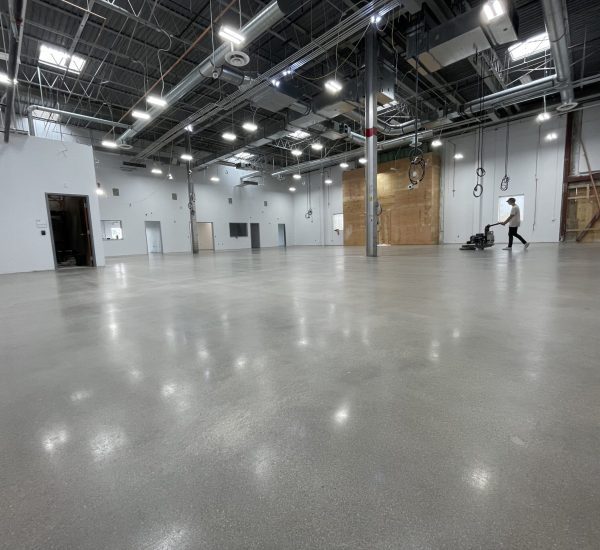
What Is Concrete Polishing — And Why Does It Matter?
Concrete polishing is not a coating or a topical product. It is a mechanical process: we use industrial diamond tooling — progressively finer grits from 30 to 3,000 — to grind, flatten, and refine the concrete surface. Mid-process, we apply a chemical densifier (lithium silicate) that reacts with the concrete to harden and strengthen it from within. The final step is a penetrating guard that seals the pores and locks in the shine.
The result is a floor where the protection is part of the slab — not sitting on top of it. That is why polished concrete does not peel, bubble, or delaminate. There is nothing on the surface to fail.
Compare that to epoxy coatings, which sit on top of the concrete and are only as good as the bond between the coating and the slab. When that bond fails — from moisture vapor transmission, thermal cycling, or heavy point loads — the coating peels. You strip it, prep again, and recoat. Polished concrete has no equivalent failure mode.
Why Concrete Polishing Matters
The Real Cost of a Bad Floor — What Neglect Actually Costs You
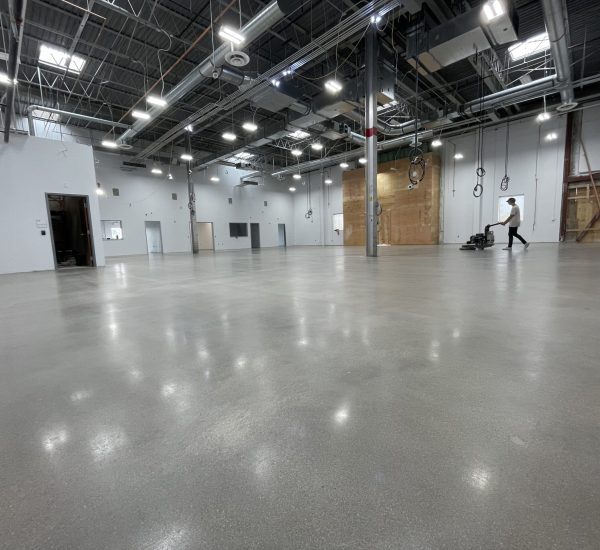
Concrete flooring is expanding its borders — and the right craftsman transforms a boring grey slab into a brilliant, easy-clean, long-lasting surface.
Energy Costs
Polished concrete has a high light reflectivity index (LRI). A properly polished warehouse or retail floor reflects significantly more ambient light than a dull, gray slab — reducing your need for overhead lighting. Many commercial clients see measurable reductions in lighting energy costs after polishing, particularly in large facilities.
Maintenance Costs
Unpolished concrete is porous. It traps dust, oils, and contaminants in its surface. Cleaning it means scrubbing, stripping, and reapplying sealers on a regular cycle. Polished concrete seals the pores. You sweep, you mop, you are done. No stripping. No waxing. No refinishing. The maintenance savings alone typically offset the installation cost within 2–5 years in commercial settings.
Replacement Costs
Most flooring products — vinyl, epoxy, tile — have a service life of 5–15 years before they need replacement. Polished concrete, properly maintained, lasts 20–30+ years without loss of performance or appearance. For large commercial floors, avoiding even one full replacement cycle over the building's life pays for the polishing investment several times over.
Fully Customizable
From matte to mirror-gloss, natural grey to custom stain colors — we tailor the finish to your exact aesthetic vision.
Works on Existing Slabs
No need to tear out or replace. We work directly on your existing concrete — saving time, mess, and money.
Our Services
Concrete Polishing Finish Options — What's Right for Your Space?
Not every floor needs the same finish. The right choice depends on your use case, the condition of your existing concrete, and how much of the aggregate you want to see.
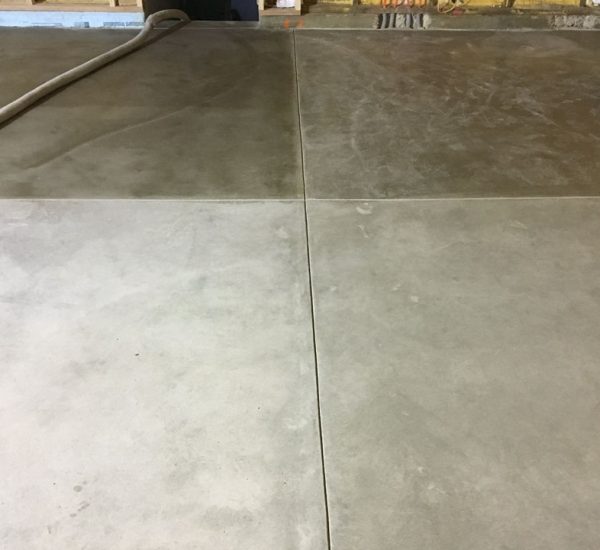
Cream Polish
The most refined look. We grind only shallow enough to remove the surface paste, leaving the concrete’s natural cream layer intact. The result is a smooth, matte-satin finish with minimal aggregate visible. Best for office environments, lobbies, and retail spaces that want a clean, understated appearance. Requires the concrete surface to be in good condition — deep cracks or patches will be visible.
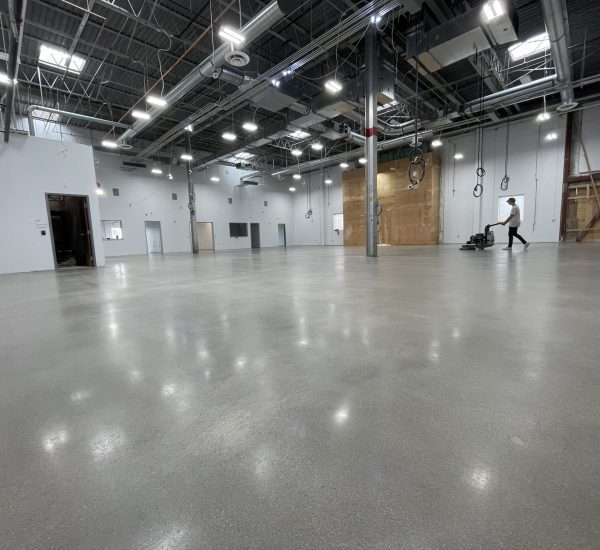
Salt & Pepper Polish
The most popular commercial finish. We grind slightly deeper to expose fine aggregate — the natural sand and small stones in the concrete mix — creating a textured, mid-gloss appearance with visible character. Hides imperfections better than cream polish and works in almost any setting: warehouses, showrooms, restaurants, medical facilities, and garages.
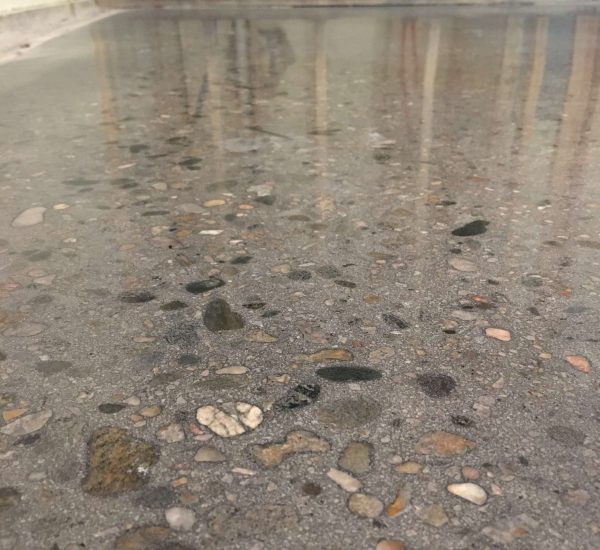
Exposed Aggregate Polish
A deeper grind that reveals large aggregate — the bigger stones in the concrete mix — for a bold, terrazzo-like look with dramatic visual depth. Popular in hotel lobbies, showrooms, and architectural projects where the floor is a design feature, not just a functional surface. Requires a concrete mix with good aggregate distribution; we assess your slab first.
Custom Finishes
We can incorporate concrete dyes and stains at any stage of the polishing process for color effects, decorative borders, logos, and patterns. Color polished concrete is increasingly common in retail and hospitality environments as a cost-effective alternative to decorative tile or stone.
Not Sure Which Service Is Right for You?
We offer a free on-site consultation — Warren personally visits and shows you a sample result before you commit to anything.
Why Choose Us
We Treat Your Floor Like It's Our Own
Warren James — owner and lead craftsman — shows up to every job personally. With over 15 years in the industry, we know that prep work and attention to detail separate beautiful floors from mediocre ones.
- Free on-site sample — see results before you commit
- Dry-grind process — zero dust mess
- Works around your schedule, including off-hours
- Strong warranty on every job
- ⭐ Google Verified
- 🏠 HomeAdvisor
- 📋 Angi Listed
- ⭐ Yelp Reviewed
Our Concrete Polishing Process — Step by Step
Every job starts with an assessment. We look at your slab’s hardness, condition, existing coatings, moisture levels, and the finish you want. That determines our tooling selection and grinding sequence. Here is what happens from there:
Step 1 — Surface Assessment & Diagnostics
We walk the floor, check for cracks, delaminations, moisture vapor emission, and hardness variations. Concrete hardness varies significantly by mix design and age — softer slabs require different tooling than hard slabs, and using the wrong diamonds wastes time and produces poor results. We identify all patches, repairs, and coating remnants before we start.
Step 2 — Grinding & Coarse Refinement
We start with coarse diamond tooling (typically 30–80 grit) to remove existing coatings, level the surface, flatten high spots, and open the concrete. This is where we set the finish level — how deep we grind determines how much aggregate will show in the final result. Any crack repairs, spall fills, or leveling work happens at this stage.
Step 3 — Progressive Honing
We move through successively finer diamond grits — 100, 200, 400 — refining the scratch pattern from each previous pass. Each step removes the scratches from the step before. By 400 grit, the floor has a consistent honed finish and is ready for densification.
Step 4 — Chemical Densification
We apply a penetrating lithium silicate densifier. It reacts with the free lime in the concrete to form calcium silicate hydrate (CSH) — the same compound that makes concrete hard. The densifier fills the open pores, hardens the surface, and dramatically increases scratch resistance. This is what separates a truly durable polish from a surface that looks good but scuffs easily.
Step 5 — Fine Polishing
After densification, we move through fine diamond tooling: 800, 1,500, and 3,000 grit (depending on the gloss level you want). Each pass increases clarity and reflectivity. At 3,000 grit, the floor has a mirror-like finish.
Step 6 — Guard Application & Protection
We finish with a penetrating lithium silicate guard — a stain-resistant, abrasion-resistant treatment that seals the surface without adding a topcoat. The guard is invisible and does not change the floor's appearance. It makes the surface easy to clean and resistant to oil, water, and chemical staining. No recoating is required — the protection is built into the slab.
Who Concrete Polishing Is Right For
Polished concrete performs in almost every setting. Here are the most common applications we handle and why each benefits specifically from polished concrete:
Forklift traffic, pallet jacks, and heavy point loads are no match for polished concrete. The densified surface handles industrial use without cracking or dusting. Improved light reflectivity reduces lighting costs in large facilities. Easy-clean surface reduces janitorial hours.
The high-gloss finish enhances the visual presentation of merchandise and vehicles. The reflective surface improves ambient lighting quality. Many dealerships report that the high-polish look significantly upgrades the perceived quality of the showroom environment — comparable to tile at a fraction of the long-term cost.
Polished concrete is non-porous, food-safe, and easy to sanitize. It handles spills, grease, and cleaning chemicals without degrading. Unlike tile, there are no grout lines to trap bacteria and debris. The look ranges from industrial-chic to polished modern depending on the finish level.
Polished concrete is an ideal medical flooring surface: it does not harbor allergens, does not off-gas volatile organic compounds (VOCs), and is easy to disinfect. The dust-free, smooth surface improves indoor air quality — a meaningful benefit in clinical environments.
Polished concrete transforms a utilitarian garage or basement into a clean, bright, livable space. Unlike epoxy, it does not peel from hot tires or moisture vapor. The finish is durable enough for vehicle traffic and visually clean enough for gym, workshop, or living space use.
Owner Operated · Free On-Site Sample
Why Under-Performing Floors Cost You More Than You Think
Dust and Air Quality
Untreated concrete ‘dusts’ — microscopic particles from the surface break off under traffic and abrasion, becoming airborne. In warehouses and industrial facilities, concrete dust degrades equipment, contaminates inventory, and creates respiratory hazards. Densification and polishing eliminates concrete dusting at the source.
Slip and Fall Liability
Polished concrete meets OSHA slip-resistance requirements. Its coefficient of friction is comparable to or better than most commercial tile floors when dry. Wet polished concrete is safer than most glazed tile surfaces. If you are currently operating on a slick, worn, or uneven floor, polished concrete reduces your liability exposure.
Lighting Efficiency
A polished floor with a high LRI (light reflectance index) reflects more ambient light, reducing the number of fixtures needed to maintain safe illumination levels. In facilities with high ceilings and large footprints, this can translate to real energy cost reductions and potentially lower fixture counts in new construction.
Common Problems We Fix Before Polishing
Many floors we work on have existing issues that need to be addressed before polishing begins. We handle all of the following as part of our prep process:
- Existing coatings — epoxy, urethane, paint, adhesive residue — ground off with diamond tooling
- Cracks — filled with semi-rigid epoxy or polyurea appropriate to your floor’s movement
- Spalls and surface pitting — filled and blended before final polishing
- Uneven joints and high spots — ground flat to eliminate trip hazards
- Stains — oil, grease, rust, and chemical stains addressed during prep grinding
- Old wax and sealer buildup — stripped and removed before densification
We tell you upfront what we find and what it will take. No surprise costs mid-project.
What to Expect — Our Process From First Call to Final Inspection
Free On-Site Assessment
We visit your facility, assess the concrete condition, discuss your finish goals, and bring sample boards showing all finish levels. You see exactly what your floor will look like before you commit to anything. We give you a written quote on the spot.
Scheduling Around Your Operations
We work nights, weekends, and in phased sections to minimize disruption. Most commercial floors can be done in sections so your operations continue uninterrupted. We coordinate with your facilities team on timing, access, and protection of equipment.
Professional Installation
Our crew uses Husqvarna and Lavina planetary grinding equipment — industry-standard machines that ensure consistent results across large floors. We run dust extraction on all grinding passes. We do not leave until the floor meets our standards and yours.
Post-Installation Inspection
We walk the floor with you at completion. If anything is not right, we address it before we leave. Our work is backed by a satisfaction guarantee.
Areas We Serve
We serve commercial and residential clients across Northern Colorado and Southern Wyoming:
We serve commercial and residential clients across Northern Colorado and Southern Wyoming:
What Our Clients Are Saying
Our Testimonials
⭐⭐⭐⭐⭐ 4.9 — Based on 67 verified Google Reviews
★★★★★
“Warren did an incredible job on our garage floor. He came out, showed us a sample, and the final result far exceeded our expectations. Highly recommend.”
— Mike T., Fort Collins CO
★★★★★
“Owner operated means you actually deal with the expert the whole time. Zero mess from the dry-grind process. The floor looks like glass. Worth every penny.”
— Sarah L., Windsor CO
★★★★★
“The free sample was what sold me. I could see the exact result before committing. The whole project was done on time, on budget, and the floor is stunning.”
— James R., Greeley CO
Common Questions
Frequently Asked Questions
With routine maintenance (sweeping and occasional damp mopping), polished concrete lasts 20–30+ years without loss of performance. The densified surface does not degrade over time the way topical coatings do. Some polished floors in commercial facilities have been in service for 20+ years with no repolishing required.
No. Despite the glossy appearance, polished concrete has a coefficient of friction that meets or exceeds OSHA standards for commercial flooring. It is safer dry than most glazed ceramic tile floors. If you need added slip resistance for specific wet areas, we can add a non-slip aggregate to the guard application.
In most cases, we can polish existing concrete. As long as the slab is structurally sound — not crumbling, severely heaved, or deeply compromised — we can polish it. We assess the existing condition during the free quote visit. Older floors with more history sometimes produce more interesting-looking results due to natural variation and patina.
A standard 5,000–10,000 sq ft commercial floor typically takes 2–4 days depending on the condition and number of grinding passes required. Residential garages and basements take 1–2 days. Large industrial floors are phased by section so operations can continue.
Pricing depends on square footage, condition of the existing concrete, finish level, and any prep work required. Contact us for a free on-site quote. We price per square foot with all prep work included in the estimate so you know exactly what you are paying for.
Not necessarily. We can phase the work section by section, working around your schedule. Many of our commercial clients operate in adjacent areas while we work. We coordinate timing with your operations team to minimize disruption.
A densifier is a chemical (lithium silicate) that penetrates the concrete and reacts with free lime to form a harder compound within the slab. Without densification, the polished surface will scuff and scratch under traffic. Densification is what makes polished concrete genuinely durable — not just shiny. Any contractor who skips this step is producing a finish that will look worn within months.
Yes. Localized damage — a deep scratch, a crack that reopens, a stain — can be repaired and repolished without redoing the entire floor. The repaired area may show some variation from the surrounding floor depending on the extent of the damage and how much traffic the floor has seen, but functional repairs are always possible.
Schedule Your Free On-Site Demo
Call 970-215-9106 or visit northernconcretepolishing.com/contact-us. We come to your location, assess your floor, bring sample boards, and give you a written quote with no obligation. We schedule free demos Monday through Saturday, 7:00 AM to 7:00 PM.