
⚡ Limited availability: Schedule this week & get a free on-site sample — Book Now →
Fort Collins, CO · Owner Operated
Most basement floors in Northern Colorado are raw, grey, dusty slabs that homeowners cover up with carpet, vinyl, or rubber mats and try to forget about. Here is the thing: that slab is already one of the most durable floor surfaces in your home. It does not rot, warp, swell, or need replacing every decade. With professional concrete polishing, it becomes a high-gloss, easy-clean, genuinely beautiful floor — one that costs less over its lifetime than any flooring you would put on top of it.
Concrete Polishing of Northern Colorado — owner-operated by Warren James, with 15+ years in the industry — transforms basement floors across Fort Collins, Windsor, Loveland, Greeley, and Cheyenne, WY. Every job starts with a free on-site sample so you can see the finished result on your actual floor before you commit to anything.
Owner operated with 15+ years of experience. We transform dull concrete into brilliant, durable floors — free on-site sample so you see results before you commit.
No obligation — on-site quote from an owner-operated expert
⚠️ Limited availability — book your slot today
On-Site Sample
Why Polished Concrete Is the Right Choice for Basement Floors
Basement environments in Northern Colorado create specific demands that most flooring options fail to meet long-term. The freeze-thaw cycles of Colorado winters, the seasonal humidity shifts, and the fact that basements sit on a slab that is in direct contact with the ground — all of these create conditions where organic flooring materials like carpet, hardwood, and standard vinyl degrade faster underground than they do on upper floors.
Polished concrete works with the environment your basement actually has, not against it.
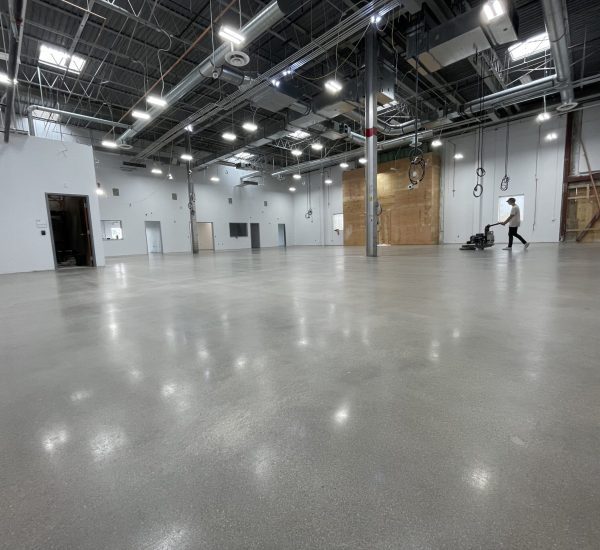
Basement slabs are naturally porous, and in Colorado’s climate they experience moisture fluctuation throughout the year. The polishing and densification process seals those pores. A properly polished and sealed concrete floor does not absorb moisture from spills, is not vulnerable to mold growth within the floor surface itself, and handles the humidity changes that would buckle wood or lift vinyl over time. For finished basements, this is one of the most practically important advantages polished concrete offers over alternative flooring.
Carpet in a basement shows wear within a few years, is difficult to clean thoroughly, and holds odors and allergens. Vinyl plank delaminates at the seams over time when moisture gets underneath it, which in basements it eventually does. Polished concrete does not wear out in the conventional sense. The surface becomes harder and more resistant through use — not weaker. A densified, polished concrete floor in a Fort Collins basement will still be performing identically in 20 years. Carpet and vinyl will have been replaced at least once, possibly twice.
Basements get used in ways that create messes: workshops, home gyms, utility rooms, kids’ playrooms, home offices, finished entertainment spaces. Polished concrete handles all of these uses. Dust and debris sweep off the smooth surface without embedding. Spills wipe up. There are no grout lines to harbor grime, no carpet fibers to trap particles, no finish that wears away and needs reapplication. For homeowners who use their basements actively, maintenance simplicity is a genuine quality-of-life benefit.
Basements are inherently low-light environments with limited natural light. Polished concrete’s high-gloss surface reflects ambient light across the room, visibly brightening the space without additional fixtures. For finished basements used as living areas, home theaters, offices, or gyms, this light reflectivity changes the feel of the space in a way that darker or matte flooring options do not.
Flooring installed over a concrete slab requires either a subfloor or a moisture barrier underlayment — adding cost, height, and a layer that can fail. Polished concrete is the slab itself, refined. There is no installation layer to fail, no transition strips between flooring types, no height differential at doorways. This simplicity is both cost-effective and structurally clean.
Why Choose Us
Warren James — owner and lead craftsman — shows up to every job personally. With over 15 years in the industry, we know that prep work and attention to detail separate beautiful floors from mediocre ones.
This is not a franchise or a large crew operation where a salesperson sells the job and a subcontractor shows up to do it. Warren James — owner, lead craftsman, 15+ years in the industry — is personally on every job. That means the assessment, the prep work, and the finished polish are all executed with direct owner accountability. When you call us, you talk to the person doing your floor.
No other flooring contractor in Northern Colorado offers this. We grind and polish a sample area on your actual floor at no charge so you can see the real result on your specific concrete before the project begins. The sample takes about 20 minutes. It eliminates every question about what the floor will look like — because you have already seen it.
Concrete polishing is a craft. The equipment, the diamond tooling, the densifier chemistry, and the reading of a slab’s specific characteristics take years to develop. We have been doing this work in Northern Colorado for over 15 years. We know the local concrete — the mix designs common in this region, the typical conditions of basements in Fort Collins, Windsor, Loveland, and Greeley, and the finishing approaches that hold up in Colorado’s climate.
Our equipment vacuums dust directly at the grinding head. There is no dust cloud filling your basement, no fine concrete particles settling on everything in the space. We can work in occupied homes without creating a cleanup project for the homeowner. The floor is polished, and the rest of the space stays as we found it.
Every polished concrete floor we complete comes with a strong warranty. We stand behind the quality of the prep work, the densification, and the finish. If the floor has a problem attributable to our work, we make it right.
Every floor starts as a unique surface. Previous coatings, adhesive residue from old carpet or tile, levelness irregularities, cracks, and concrete mix variation all affect the starting condition. Our process assesses your floor first, then works through it systematically.
Warren visits your Fort Collins, Windsor, Loveland, Greeley, or Cheyenne property and assesses the floor condition. We grind a small sample area on your actual floor — at no charge — so you can see the finished result before committing. No guessing from photos. No surprises on the day of installation. What you see in the sample is what you get on the full floor.
Surface prep is the step that separates a professional result from an amateur one. We remove any existing coatings, adhesives, or surface contaminants, address cracks and spalls, and grind the floor level where needed. A floor that is not properly prepared before polishing will show every flaw through the finished surface — prep is not optional, it is the foundation of everything that follows.
We use a sequence of diamond tooling — starting with coarser grits to cut the surface, progressing through increasingly fine grits to develop the smoothness and reflectivity of the finish. Each pass removes the scratch pattern from the previous one. The number of passes and the grit progression determine the final gloss level, from a satin matte to a high-mirror polish. You choose the finish level that fits your space and how you use it.
After grinding, we apply a chemical densifier that penetrates the concrete and reacts with calcium hydroxide in the slab to form a harder, denser surface material. This is what gives polished concrete its durability — the densifier makes the surface harder than the original slab, which is why polished concrete outperforms the base material it started as.
We bring the floor to its specified finish level with final-stage polishing, then apply a sealer appropriate for the use — whether that is a penetrating sealer for a more natural look or a topical sealer for maximum stain protection in a high-use basement space. Our process is entirely dry-grind — all dust is vacuumed directly by equipment built into the machinery. Your basement does not become a dust event. When we leave, the floor is finished and the space is clean.
Why Concrete Polishing Matters
For finished basements used as family rooms, home theaters, or guest spaces, polished concrete with staining creates a high-end look that competes with premium hardwood or tile at a fraction of the long-term cost. The reflective surface brightens the space. The stained color adds warmth and visual interest. And the durability means you will never resurface it.
Gym flooring in basements takes abuse. Weights dropped, equipment dragged, sweat and moisture from workouts — polished concrete handles all of it without degrading. It is harder than rubber mat flooring under impact, easier to clean, and does not collect odors. Many homeowners pair polished concrete with rubber mat zones only under weightlifting areas, leaving the rest of the floor bare polished concrete.
For workshop basements, the practical advantages of polished concrete are significant: oil and chemical spills wipe up rather than soaking in, the harder surface resists scuffing from tool movement, and the brightness of the polished surface improves visibility for detailed work. A densified, sealed concrete floor is also easier to keep clean in a workshop environment than raw concrete or vinyl tile.
The low-maintenance, durable qualities of polished concrete suit home office environments well. Clean, professional appearance with no upkeep — no vacuuming, no refinishing, no replacing worn sections. And in a space where you spend focused hours, the clean visual simplicity of a polished concrete floor is aesthetically appropriate in a way carpet often is not.
What Our Clients Are Saying
⭐⭐⭐⭐⭐ 4.9 — Based on 67 verified Google Reviews
EXCELLENT Based on 75 reviews
 Posted on Google
 Tanya MielkeWarren did a great job on my concrete floors. He worked with me on scheduling and got the job done FAST! My floors got a second life! Highly recommend.Posted on Google
 Jim CursleyI’ve been a builder and general contractor for 25 years; I’ve seen it all: good, great, fantastic and horrible. Warren and Concrete Polishing of Northern Colorado are firmly in the fantastic category.Posted on Google
 Brian JonesConcrete Polishing of Colorado did a tremendous job finishing our patio! They were able to grind down the top of 1/2 new and 1/2 old concrete, each with different color tones and make them match. The crew did great and Warren was also great to work with! Would highly recommend.Posted on Google
 Kathleen SpielmanThe crew was very professional and clean. They did an great job!Posted on Google
 Andy RexWarren and his crew did a great job prepping a concrete basement floor in an old town renovation. Very responsive to my calls/texts. Great work. I will use them again!Posted on Google
 Jeff HeatonWarren and his crew are great. Communication and quality of work are on point. They polished a commercial unit floor and an exterior patio for me. Don’t hesitate to use them.Posted on Google
 Gary PickeringVery skilled craftsmen. Did a great job for us and finished the job on time and within budget.Posted on Google
 Bryan SchoskerWarren and his crew were great. Highly recommend for residential or commercial job.Posted on Google
 Michael WellnitzGreat job and fastPosted on Google
 AndrewThese guys are amazing at what they do. They take pride in their work, and get the job done!Verified by TrustindexTrustindex verified badge is the Universal Symbol of Trust. Only the greatest companies can get the verified badge who has a review score above 4.5, based on customer reviews over the past 12 months. Read more
Common Questions
Almost all basement slabs in Northern Colorado can be polished. The exceptions are floors with extensive structural damage, floors poured with lightweight or specialty concrete mixes not designed for polishing, or floors that have been treated with certain chemical products that contaminate the surface at depth. We assess your floor for free and give you an honest answer before any commitment.
Minor cracks are common in basement slabs and are addressed during the surface prep phase. We fill and repair cracks before polishing. The finished floor will show that cracks were there — concrete is not a uniform manufactured material and its character shows through the polish — but they will be structurally addressed and will not worsen or allow moisture entry.
A typical residential basement floor takes one to two days depending on square footage, the condition of the existing surface, and the finish level specified. We give you a specific timeline at the free assessment. We work around your schedule, including evenings and weekends if needed.
Concrete does not retain heat the way carpet does, and basements are naturally cooler spaces. That said, most finished basement owners add area rugs in seating areas, which addresses any comfort concern while keeping the visual character of the polished floor. In workshop, gym, and utility basement applications, the temperature of the floor is rarely a consideration.
Properly densified and sealed polished concrete is significantly more moisture-resistant than raw or painted concrete. The densification process closes the pores at the surface, and the sealer adds a protective layer. This does not eliminate moisture vapor transmission from the slab — no surface treatment does — but it prevents surface moisture from penetrating and causing the floor to deteriorate. For basements with active water intrusion issues, we assess those conditions at the free evaluation and discuss whether polishing is appropriate or whether moisture remediation should happen first.
Yes. Concrete staining is available as an addition to the polishing process — see our concrete staining service page. Staining can add uniform color, create visual warmth, disguise patches and repairs, or add decorative character. The stain is applied after prep and before the final polish passes, locking the color into the surface rather than sitting on top of it.
Not sure if we reach your location? Call (970) 215-9106 and we’ll confirm directly.
The free on-site sample is the only way to know what your specific floor will look like polished — not someone else’s floor in a photo. Warren will come to your home, grind a sample area on your actual concrete, and show you the result in person. No cost, no obligation, no sales pressure.